Thursday, January 21, 2010

What net communities do I live in?

Shel Israel asked me about strengths and weaknesses of communities I belong to. After rattling some brain cells around, here's my answer. But first, the questions:

  • ASUG vs. other communities (SAP Community Network, or SDN)
  • Are people in one or the other?
  • Why am I in more than 1?

ASUG vs.

I was an ASUG member before SDN existed, which might explain my feistiness when people say "are you going to SAPPHIRE" and I always reply "No, I'm going to the ASUG conference", co-located or co-opted by SAP Sapphire. I've put a lot of my personal and professional time into the Americas' SAP Users Group. I fully believe in our position as the "leading customer-run SAP resource in the world," " the largest independent, not-for-profit organization of SAP customers" and "the leading resource for SAP customer-driven education." We're regional, SDN is global. We're a non-profit organization (legally); SAP community network is run by SAP, a stockholder owned for-profit corporation. We're run by volunteers. SAP is run, by, well, a command and control German machine.

ASUG members are companies who run SAP, consultants who work in the SAP space, and SAP employees. Anyone who works for a member company can join ASUG, so while there is an annual fee, it should be a trivial cost per person. SDN is "free", although I could argue that it is subsidized by the software costs and maintenance fees paid by customers. ASUG volunteer leaders (folks like me who work at companies that use SAP software) choose content for the annual program; SAP content at TechEd and Sapphire is chosen by SAP marketing teams.

As for web site content, more serious differences appear, many to ASUG's disadvantage. SAP, being a huge global software firm, has an enormous infrastructure of hardware, application developers, and full time paid, world-class content managers. ASUG has a small footprint, both at the organization HQ, and in the volunteer cadre that attempts to keep the content timely and lively. We've seen a significant drop in web site traffic that can be traced to the growth of SCN.

I'm an SAP Mentor, an SCN Moderator, an SDN Top Contributor, and an ASUG Year-Round Community Facilitator. What does that mean? The first category are folks chosen (by SAP, but nominated by peers) to be a think tank. There are many pluses, but some minuses to this. It's a highly visible position, so the grumbling and ranting one might get away with in a small community doesn't fly well in the jet set. And there are times when SAP seems to want us more for marketing advantage than for focus-group or constructive criticism. I'm on the record objecting to their for-profit education and certification programs. Yes, good training is expensive, but a piece of paper (or electronic simulacra) is not a guarantee of quality. I'm not certified as anything, by the way. Mentors are supposed to be the top Nth percentile of the global SAP community.

SAP Mentor Initiative FAQs


Moderators are another breed, although there are some who act both as Mentors and as Moderators. I'm more active as a mentor, I guess, but try to keep busy moderating the forums, blogs and wikis on SDN. The die-hard moderators who deal with the hundreds of messages and posters, particularly the annoying minority who just don't get what a community network is, have my undying admiration. I don't believe the moderators get anywhere near the rewards that Mentors get (though I could be wrong); they're fighting the good fight because they believe in it, not for the recognition or glory.


Mentors get the "(!)"; moderators get the "[M]".
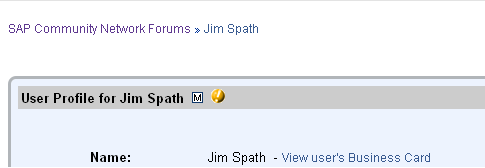


Top contributors are those recognized by SAP community network management as posting a lot of good material on the site. I've been in the top for the last couple years in the "Technical" category, as I write a lot about infrastructure, problem-solving, and software maintenance.


ASUG community facilitators were called group leaders before groups were renamed to be communities. They (groups or communities) consist of several special interest groups, which could be called communities in their own right, or maybe sub-communities. Like SCN, ASUG has sets of communities, organized into technical, process, and industry specific. We had process groups long before SAP came up with the business process expert label. And, we also have chapters, which SAP does not have, except maybe sales regions. ASUG has many geographic areas across the U.S. and Canada that run quarterly meetings, including networking, presentations, and vendor displays. SAP has recently begun having international "Inside SAP" meet-ups, often organized by SAP Mentors. My opinion is that we already have these in the U.S., and it's counterproductive to host competing sessions in the same area.

I could go on about how deep the knowledge is in our vertical communities, especially long-standing teams such as oil and gas, and utilities, but I'm going to hang my hat here, so to speak, with my video (shown at SAP TechEd 2009), the Many Hats of an SAP Mentor:

start video:


end video.

Are people in one or the other?

When we have software issues at work, we'll look on ASUG, SDN, OSS, or open a ticket with SAP support, probably in that order, although much depends on the nature of the issue. Software bugs, pop-up messages, etc., would drive someone to the online support system looking for an issue report. "How do I" questions might lead them to SDN, as long as the search doesn't take too long. But deeper strategic questions of "which module should we switch on" or "does this bolt-on cause side effects" are much more likely to be answered by savvy long-time SAP customers found via the ASUG site. We list their name and company, something SCN doesn't always force.

Whether all companies have the bandwidth to cast such wide nets I can't really answer, though I would guess not many are very active in both ASUG and SCN. I think once people latch onto a community that answers their needs, only high noise levels or traffic atrophying will drive them off. I know that I've brought several SCN contributors into ASUG conferences as speakers, including Richard Hirsch and Harald Reiter. Free admission to ASUG and Sapphire both for speaking? Sure!

Why am I in both?

It's definitely a result of the bridge-building by Marilyn Pratt that 6 of my fellow BITI volunteers are SAP Mentors. Without her forcing the question of "how can we all get along" we'd probably have continued our separate ways.

That's what started us down this path; why does it continue? First, I'm having a lot of fun with both groups. And they have their own rewards. Second, my management continues to see the value of having a global network to turn to for enterprise software management. We've had any number of volunteers drop by the wayside because they or their companies couldn't or wouldn't keep up the momentum.

Third, I'm stubborn. I'll hack and hammer at problems until they are vanquished. As Robert Plant and Sandy Denny sang in The Battle of Evermore:

Tired eyes on the sunrise,
Waitin' for the eastern glow.

Tuesday, January 5, 2010

Jingle Bell Beaver Day 2009

We arrived at Broad Creek Memorial Scout Reservation early enough to enjoy a donut and coffee or 2 before moving on to our assigned service project. This year, Ranger Dave asked if we would work on the Red Trail. Since I'd been through there earlier in the year, I knew about where to go and what needed to be done.

We outfitted ourselves with loppers, shears, grass whips and pruning saws, as well as a bow saw or two. In hindsight we should have double checked the tool sharpness, and brought at least one axe.

The first leg in the morning was the area east of the "police" range in Camp Finney. The gate was locked, so we parked outside and walked around the fence.

http://www.panoramio.com/photo/30519764


The large tree to the left needs a better blue blaze.

We cleared the sticker bushes as best we could. Since this is where the trail turns away from the fence, the blazes and path need to show the turn. After working east for about 30-40 minutes, we reached a service road that did not need any maintenance, so turned back west.

On the other side of the range is a pine tree "plantation" - laid out in straight rows, all around the same age. Unfortunately, parts of it are dying, and the lower sections of the healthy part are very fragile.


From Scouts - general

Above you can see Troop 350 clearing the few weeds; below you can see the trail crew relocating one of the dead trunks from the trail tread.


From Scouts - general


One last obstacle removal before the Camp Finney Road is posted to Flickr as a composite photo:


Troop 350 takes out a maple limb

After an awesome lunch at Camp Spencer, we picked up where we left off, parking a bit farther west on the Camp Finney Road to cut down on travel time to the trail.

The Red Trail follows the road south for a bit, then turns west into the wood. That trailhead is overgrown, so we worked on clearing it.


From Scouts - general


Later that day it looked a lot better:

http://www.panoramio.com/photo/30519914


The area I noted earlier in 2009 as needing more blazes is still undermarked.

See this (also in Google Earth):

http://www.panoramio.com/photo/25183738

Further on the trail we cleared a leaning pine tree.

From Scouts - general


...

From Scouts - general


It looks like our SPL grew a moustache while we worked.

This one needs axe or chain saw so we'll need to come back:

http://www.panoramio.com/photo/30520260

Near the end of our day we found another large trunk across the trail, as well as a vague direction for the tread due to the amount of leaves down.


From Scouts - general

I put the "after" picture in Panaramio, which has already been selected for Google Earth.


Now I just need to verify those GPS coordinates.

Does 39° 42' 11.76" N 76° 15' 36.15" W sound right?

Waypoint #20 on my ETrex was:

N 39 42.199 39.70332
W 76 15.552 76.25920

Tuesday, December 29, 2009

Mastering OALM

Nentico Lodge is transitioning to a new membership database. In the process of centralizing the storage, we're distributing the data integrity responsibility. It's going to be an interesting next few months. Chesapeake Chapter will be first out of the gate as we have the earliest Ordeal in calendar year 2010. Here are a few comments from my perspective - non-authoritative, unofficial, and maybe helpful.

First, a process flow chart. I came up with this after working on the volume test in early December. It's broken into 2 main areas - Unit Elections, then Chapter Ordeals. The reason for this should be obvious, though the data hand-offs from unit to chapter, and from chapter to chapter, will need to be tested to see how it works.

The "In" circles are where someone will be entering data, either the Chapter Adviser or their designee. Likewise, the "Out" circles represent data reports, on-screen, on paper, or to various media formats. As an example, reports back to Scoutmasters on those elected can help find spelling mistakes or other inaccuracies. I've left out validation of BSA ID numbers for simplicity, but that needs to happen somehow.


The second page, the Ordeal process, looks more complex, but will probably be simpler in practice. The bigger adjustment at the Ordeal will likely be managing the transition from the "old way" to the "new way." I've seen challenges with pre-registration, especially when the forms don't make it to the Ordeal site on time. With a central database, this can be avoided with the up-to-the-minute synchronization process.


The trick to simplifying check-in will be to have as many of those elected on the records as possible. Given that April's Ordeal could include elections as far back as late April or early May 2009, it would not surprise me if someone showed up whose data was not online yet. We'll need a way to make sure they are recorded and the elections are checked.

Here is one screen shot of menus I saw during a test phase:


A few things to note about this:

  • Someone has to set up events if I can't access "Event Manager". For best results long term, we should agree on a format so they can be more easily found.
  • Membership Manager needs some practice, and also some rules around capitalization, abbreviations, etc.
  • Chapter Reports are useful. Once we're back online I'll highlight a few I found. I should have taken screen shots before, so there you go...
  • Unit Contact Manager sounds like an address book, but it seems to be more of a calendar showing who was contacted when. It's probably useful for tracking many elections, though it will take some time to become familiar with it.
  • There are exception reports, including a nice one that can do partial name matching to search for duplicates or typos.
  • I think Service Hours can also be used for meeting attendance. Again, once we're online I will try this at a Chapter meeting to wok out the kinks.

We talked about whether this tool can help the Extended Elangomat program. I believe it can, based on the reporting and organization logic. I hope so.

Lastly, this cryptic pop up:


The answer is not always one or the other. It depends what you want to do. So read, understand, then choose.

Saturday, December 5, 2009

Eagle Court of Honor - Henry Sentz

Tonight, after spending a day at Scout Camp, I was privileged to assist at the Eagle Court of Honor for one of Troop 350's Scouts. After years of work, Henry met all of the requirements, with weeks to spare before his 18th birthday.

In this photo, Eagle Scout Lou Maggio Jr is leading the Eagle Charge and pledge.

Monday, November 30, 2009

Rediscovering trails in Gunpowder State Park

In the geocaching.com site, there are 2 caches described along parts of the Orange and White trails in Gunpowder State Park:

(1)

(2)

I'm rather partial to these, even if my troop isn't the one listed on the one remaining "Nature Trail" sign, we've done a bit of trail maintenance there. Plus, the image on one of these cache pages is of an Eagle project by our troop.

The Friday after Thanksgiving we gathered at the Marina to begin a few hours of trail service. Besides a lot of leaves and branches in the trail, the Park Rangers wanted us to fix up some faded or missing blazes, and rework a couple of muddy sections.

The first photo shows Sam, Tom, and Mr. Joe placing rocks to forge the wettest area, while Kyle widens the trail step on a slightly drier area.


In the second photo, Sam is blazing a new marker using our impromptu duct tape stencil.


Here's what one of the fords looked like when we were done.

Saturday, October 24, 2009

Pumpkin carving at Elk Neck State Park

Cub Pack 350 is camping out at Elk Neck State Park, along with some of Troop 350. There are lots of activities to keep them busy despite the rain, with nature hikes, beaver dam viewing and pumpkin carving.

There's a pie baking in the Dutch oven. I'm Hungry!

Thursday, October 15, 2009

Butch in Phoenix

Butch McNally joined other SAP Mentors Graham, Sue, Gretchen and I at the Matador Restaurant on the last evening of SAP TechEd 09. A great night, mates.